


Plenty of Surprises from Pittsburgh
Please be aware that some locations may have restrictions do to current health concerns.
When looking at a map of the United States, it’s a bit challenging to explain where Pittsburgh, PA, is to someone who’s never been there. It’s not on the east coast. It’s kind of in the midwest. It’s definitely more northern, but not like Erie, PA north. Many people would be surprised to learn that at one time, Pittsburgh was referred to as “the Gateway to the West.” In the early 1800s, very little was known about the land beyond Pittsburgh, and with its direct access to the Allegheny, Monongahela, and Ohio Rivers, it seemed that the city was a launching point to the wilderness.
These rivers are the reason Pittsburgh is the lively, thriving city we know today. Being centrally located to multiple trade routes from the north, south, east, and west made the city a hub for commerce, especially in coal, timber, glass, natural gas, iron, and other natural resources that were abundant in the Appalachian area. This vast source of water was also crucial for the production of steel, and in the early 1900s, Pittsburgh was the source of over half of America’s steel production.
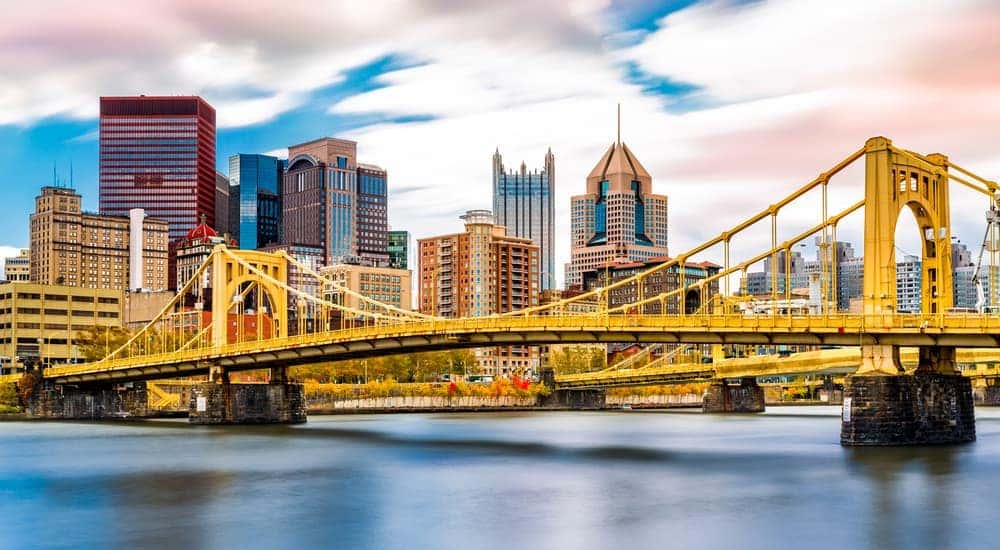
For many, these historical roots are called to mind whenever Pittsburgh is mentioned. “The Steel City” or “The City of Bridges” has earned its reputation for heavy trade, commerce, and industry, yet few people are aware of the rare experiences that can only be had in the PGH. With all of that said, we at Colonial Motor Mart wanted to share some of our favorite places to go and things to do in Pittsburgh. So, let’s get into it, starting with some outdoors fun!
What Goes Up
Some people prefer the road less taken. Others still like to take the hardest road possible. And Pittsburgh has three famous inclines that take the concept of “going up” to the extreme.
The first is Canton Avenue. What is technically a simple, regular neighborhood street is, in fact, the Steepest Street in the United States. The measured incline is 37%, which means for every 100 feet traveled, you’ll gain 37 feet of elevation. Thankfully, this part of the road is only 1/10 of a mile in length. Pittsburgh’s annual “Dirty Dozen” bike race takes advantage of the area’s hilly terrain by sending bikers over 13 local peaks, though none inspires as many crashes as Canton Avenue. Paved in cobblestones, the incline is truly to be taken seriously by anyone who tries to summit!
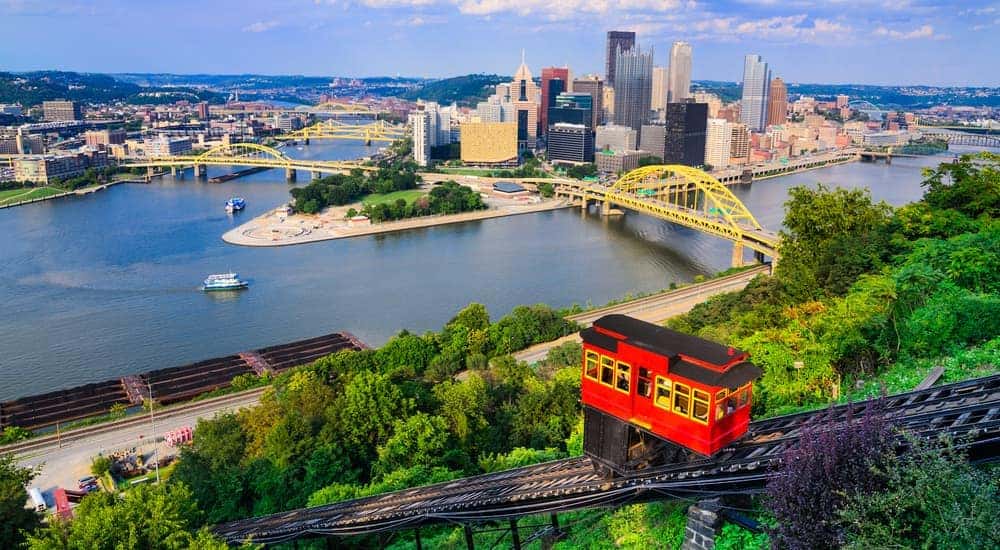
Of course, not all hills are meant to be climbed on foot. The Monongahela Incline was created to combat that exact situation. In the mid-1800s, coal, and steelworkers who lived in the scenic and peaceful hilltops often had long, dangerous commutes on foot to their factory jobs in the valleys below. Drawing inspiration from the funicular railways in Germany, these workers- many of whom were German immigrants- worked to build the Monongahela Incline between 1869 and 1870. The oldest funicular railcar in the United States is still operating today, taking intrepid travelers up and down Mount Washington for spectacular views of the city and beyond.
In fact, Pittsburgh was once home to a multitude of these inclines, though few are in operation today. Luckily, Monongahela’s baby sister, the Duquesne Incline, is still bravely chugging up the mountainsides. Perched over the waterways that made the city famous, why not check out all the views of the city. After all, what’s more, “fun” than a “funicular” railway?
These ARE the Droids You’re Looking For
That said, if you prefer some indoor fun and you’ve been on the hunt for C3PO and R2D2, here’s some good news: they’re in Pittsburgh, hanging out with their audio-animatronic pals at the Robot Hall of Fame. Located within the Roboworld exhibit at the Carnegie Science Center, the Robot Hall of Fame honors the innovators, the celebrities, and the AI heroes within the world of robotics. From the Roomba to HAL, you’ll have the opportunity to come face to… ocular sensors with all of these mechanical creations.
In fact, Pittsburgh has actually come to be affectionately known as “Roboburgh” in recent years, due to the founding of the Robotics Institute at Carnegie Mellon University in 1979. More than 60 robotics-based companies make their home in the county. With some of the nation’s leading engineering, robotics, technological, and design programs available at nearby Carnegie Mellon University and the University of Pittsburgh, it’s no surprise that mechanical innovation should be so prevalent in Allegheny county.
While you’re at the Carnegie Science Center, you’ll also have the opportunity to explore western Pennsylvania without leaving the building. The world-famous Miniature Railroad and Village that now makes its home at the Science Center was the loving creation of a fellow named Charles Bowdish of Brookville, PA. What started as a holiday display has continued to grow since 1919, and now measures 83 feet long by 30 feet wide, and includes 105 animated scenes, over 250,000 trees, and 85 automobiles. In fact, if you look closely, you’ll find the Monongahela Incline faithfully reproduced within the scenery!

Seeking Relaxation in Urban Areas
For those interested in a more relaxing experience, there are many churches, chapels, and cathedrals that are both breathtaking in appearance and humble in their service to their beliefs. One renowned place of worship is St. Anthony’s Chapel at 1704 Harpster Street, Pittsburgh. Its founder, Father Mollinger, was himself a Belgian immigrant. Before being called to the church, he was a practicing medical doctor. Upon his arrival in Pittsburgh in the 1800s, he discovered there were no doctors in the area, and established his chapel and an apothecary to provide medical treatment for all who needed it.
He brought with him a large collection of religious relics, including the skulls of saints, bone chips collected from each of Jesus’ Apostles, splinters from the cross of Jesus, and a fragment torn from the Virgin Mary’s veil. All told, there are over 5,000 relics within St. Anthony’s Chapel, many of which were used in Father Mollinger’s healing procedures. In fact, a portion of the museum area is dedicated to the canes, crutches, and eyeglasses cast off by the healed.
Bear in mind that St. Anthony’s Chapel is a working Catholic house of worship before planning your visit. Despite having the largest collection of religious relics outside of the Vatican, it is important to note that services are conducted at this location, so plan accordingly.
There’s another type of cathedral in Pittsburgh that requires a visit for an entirely different purpose. As the University of Pittsburgh rose in popularity in the early 1900s, a problem arose: how would the school manage to create enough space for the students who arrived en masse? The answer, of course, was to build up, not out.
Rising 535 feet high, the Gothic-style tower designed by architect Charles Z. Klauder and located at 4200 Fifth Ave, Pittsburgh, became known as “The Cathedral of Learning.” Inside is a stone common-room that soars three stories high, as well as 29 different learning rooms. The Cathedral of Learning is unique in that each room is decorated in a highly unique manner.
In order to involve the community, the university decided to provide one room to each of the nationalities participating in the growth and achievements of Pittsburgh as a city. Known as “Nationality Rooms,” each room is decorated in a manner that reflects the traditional elements, artifacts, and aesthetics of the native region. Each room, therefore, has its own distinct characteristics that take visitors to another time and place.
While many of the rooms are still used as working classrooms for the University of Pittsburgh students, visitors may tour the rooms when class is not in session. Some rooms are designated historical displays and may be toured for a fee. But in general, they are all worth the visit.
Far Beyond Coal and Steel
While Pittsburgh may never shed its reputation as a center of industry, trade, and commerce, there are still many links to the past that focus on the cultural and innovative spirit of the people who have made the city home. From overcoming steep climbs to finding a way into the future through science, and even creating sublime homes for healing and learning, Pittsburgh’s industrious nature goes far beyond coal and steel.
0 comment(s) so far on Plenty of Surprises from Pittsburgh